
Short-Term Rental Cleaning Costs: How to Set Fees and Manage Expenses
Cleaning is the single biggest operational cost in short-term rentals. Learn how to calculate fees, set cleaning charges without putting guests off, and handle the tax side correctly.
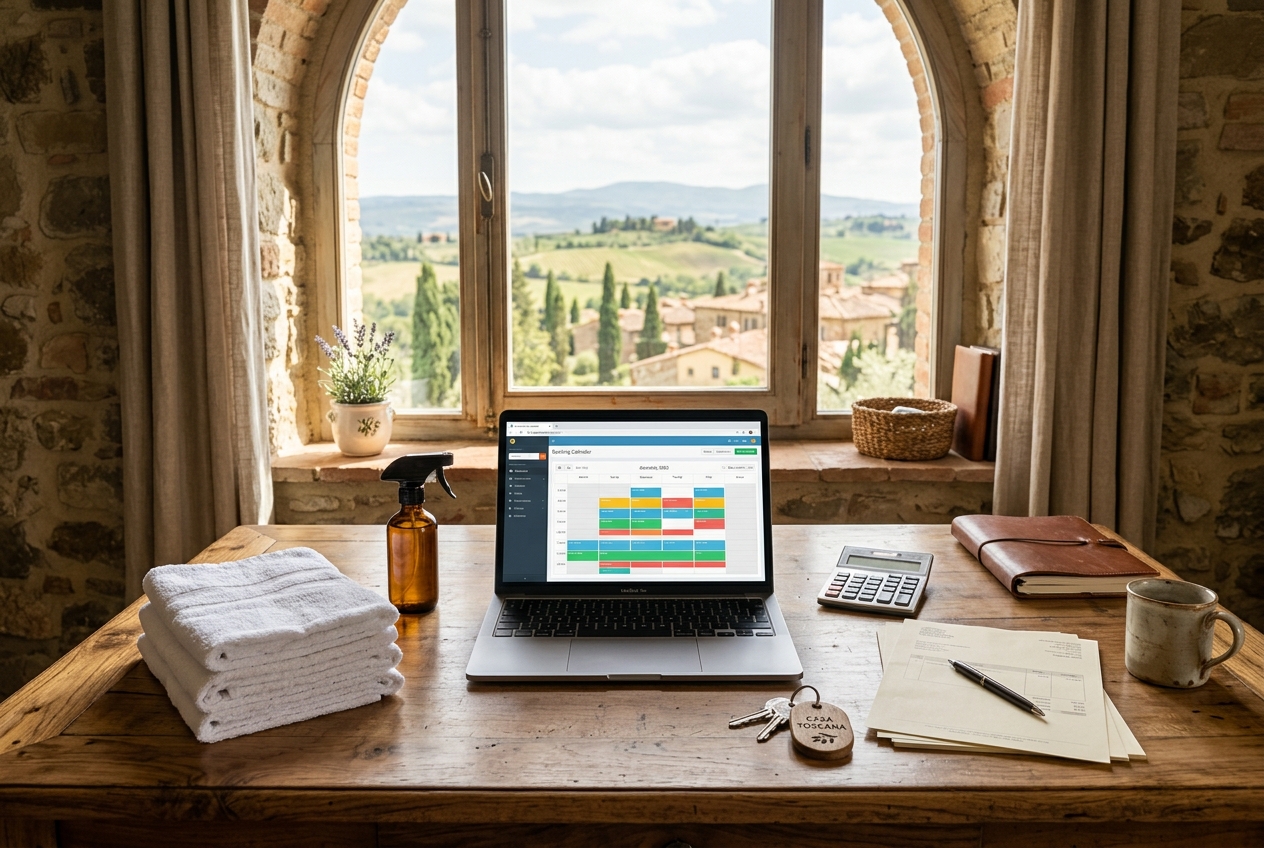
Managing cleaning is the single biggest operational cost for short-term rental hosts. Getting the numbers wrong means either eating into your profit margins or scaring off potential guests with excessive charges at the booking stage.
To maximise the return on your holiday home in the Grosseto area, you need to balance your rates, optimise your tax position and automate your processes. Here's how. This article is part of our complete guide to short-term rental cleaning in Grosseto.
In brief: cleaning costs are the main operational expense at every guest changeover. A flat per-checkout fee works best — charge guests only part of the real cost and recover the rest through your nightly rate. Under the Italian flat-tax regime (cedolare secca) cleaning costs are not deductible; under a business structure they are.
What are cleaning fees on Airbnb?
Definition: cleaning fees on Airbnb and other OTAs (Online Travel Agencies) are a fixed, one-off charge that hosts add to the total booking cost to cover turnover cleaning, sanitisation, linen laundering and guest amenity replenishment between stays. They do not vary with the number of nights — they apply once per stay.
How to set cleaning fees without putting guests off
The most common mistake is passing 100% of the real cleaning cost on to the guest, inflating the final price — especially painful for one- or two-night stays. The best strategy for maintaining a high conversion rate is partial absorption:
- Increase your Average Daily Rate (ADR) slightly.
- Keep the cleaning fee line visibly lower and in line with the local Maremma market.
- Guests perceive a smaller surcharge, while you recover the margin spread across the nightly price.
| Strategy | Cleaning fee shown | Nightly rate (ADR) | Effect on 1–2 night stays | Effect on margin |
|---|---|---|---|---|
| 100% of cost passed to guest | High | Unchanged | Inflated total price, fewer bookings | Covered only if guests book |
| Partial absorption (recommended) | Low, in line with local market | Slightly higher | Lower perceived price, better conversion | Recovered in the nightly rate |
| No cleaning fee | Zero | Much higher | Less competitive nightly price | Risk of not covering costs on short stays |
To estimate how much your property could earn net of these costs, use our earnings calculator.
Flat-rate vs hourly cleaning: which works better for owners?
When you work with a cleaning company or professional cleaners, you will typically encounter two pricing models:
- Hourly rate: often offered by traditional cleaning staff. It looks attractive but hides serious pitfalls. A difficult changeover or a particularly messy departure will push the hours — and the cost — up, making it impossible to calculate reliable margins.
- Flat rate (recommended): the model used by professional property management agencies. A fixed price is agreed for each checkout based on the property type (for example, a one-bedroom apartment in Marina di Grosseto). You know exactly what every turnover will cost, regardless of whether it takes two hours or four to restore hotel-level standards.
| Criterion | Hourly rate | Flat rate |
|---|---|---|
| Cost predictability | Low: depends on how guests leave the property | High: fixed price per checkout |
| Property left very dirty | Cost increases | Cost stays the same |
| Margin calculation per booking | Difficult | Immediate |
| Typically offered by | Traditional cleaners | Professional property management agencies |
| Suitable for growing a business | No | Yes |
Linen costs are also part of this picture. If you are weighing up whether to buy or rent your linen, read our comparison on linen rental vs purchase for short-term rentals.
Tax implications: deducting cleaning company costs
One of the most debated topics among owners is the deductibility of these expenses. The tax impact depends entirely on your setup:
- Flat-tax regime (cedolare secca): if you rent as a private individual applying the cedolare secca (21% on the first property), the tax is calculated on 100% of the gross rent collected. In this case, costs for the cleaning company and laundry service are not deductible.
- Standard IRPEF as a private individual: even under standard income tax, rental income is treated as property income (reddito fondiario): individual cleaning expenses cannot be deducted — only the statutory flat-rate reduction on the rent applies.
- Business structure: if you run the activity as a business (sole trader or company, such as an SRL), invoices from cleaning companies, linen management services and property managers become deductible costs. This reduces your taxable base and optimises the overall tax burden of the property operation.
Every situation is different — always consult your accountant before choosing the most appropriate structure.
| Structure | How tax is calculated | Cleaning, laundry and property management deductible? |
|---|---|---|
| Cedolare secca (private individual) | Fixed rate on gross rent | No |
| Standard IRPEF (private individual) | IRPEF rates on rent with statutory flat-rate reduction | No — only the statutory flat-rate reduction |
| Business structure (sole trader or company) | On business income: revenue minus costs | Yes, with a valid invoice |
How property management software automates communication
The real hidden cost of cleaning is the time wasted on the phone coordinating your team. Modern operations leave no room for forgotten WhatsApp messages or misunderstandings.
By using professional Channel Managers and PMS (Property Management Systems) such as Lodgify or Kross Booking, every reservation can be synchronised. Through integrations and webhooks — for example with automation platforms like Make.com — the check-in and check-out calendar is sent to the cleaning team in real time. Turnovers happen automatically: the cleaning crew knows exactly when to arrive, ensuring key boxes are always ready and every property is guest-perfect by 3 pm.
A well-organised clean shows directly in your reviews. In our guide to Airbnb cleaning standards for 5-star reviews you will find the checklist we use at every changeover.
Frequently asked questions about cleaning costs
Do Airbnb cleaning fees vary based on the number of nights?
No. Cleaning fees are a fixed, one-off charge applied to each stay, regardless of the number of nights booked.
How much should I charge guests for cleaning?
It is best to show a modest cleaning fee in line with the local market and recover the gap between that and the real cost through a slightly higher nightly rate. This keeps the total price for short stays competitive.
Are holiday rental cleaning costs tax-deductible?
It depends on your tax structure. Under cedolare secca and standard IRPEF as a private individual, they are not. Under a business structure, with a valid invoice, they are. Always check your specific situation with your accountant.
Scale your business with Managebnb
Ready to stop chasing cleaners, washing machines and misaligned calendars? At Managebnb we offer integrated property management, professional cleaning and guest amenity supply services across the whole Maremma area.
We work on a flat-rate basis, issue proper invoices and integrate with your booking systems to give you a completely stress-free operation. Contact us to optimise the profitability of your property.